
The Brides Ballad
Marry in September's shine, your living will be rich and fine
Traditional English folk rhyme
Welcome to The Bride’s Ballad.
Brought to you by Lavender & Jude - the bridal boutique perched on some of the UK’s easternmost shores in Southwold, Suffolk - The Bride’s Ballad is a curious compendia of the legends, traditions, seasonal lore and superstitions that surround brides and weddings. Each month brings a new verse, using a different material, object or colour as our compass.
We hope that you will join us on a gentle amble through the folkloric and the fanciful, the traditional and the transgressive as we unpick the seams of the old ways and trace their echoes in the new.
Wheat Field By William Page Atkinson Wells
Marry in September's shine, your living will be rich and fine
Traditional English folk rhyme
The almanac
These hazy days as late summer wanes into autumn have always been a special, in betwixt time. If the year has been kind, it brings plenty, bounty and abundance. Daylight may be diminishing, the leaves tainting and crisping but there is still a quiet, magic energy. Summer recedes but reminds us of her power with deceptively warm days, while leaden skies and distant thunderstorms can stir overhead.
On these British Isles, the harvest is drawing to its close, heralding a time for gleaning, gathering and gratitude before we turn in for the darker months ahead. Golden fields that have simmered all summer lose their lustre as they are shorn of their flaxen bounty, reduced to swathes of stubble after the cereal crops are brought in.
The month reaches its apex with the autumn equinox, otherwise known as Mabon, the second of three harvest festivals if you follow the Wheel of the Year. This particular spoke falls today - on the 23rd September. Traditionally, the full moon that rose closest to the equinox marked the harvest festival, when lavish celebrations and revelry would honour the homecoming of a successful harvest. The harvest home - known in this corner of East Anglia as the ‘horkey’ - was held before harvest officially ended on St. Michael’s Mass (29 September), and was a communal celebration rich with song, dance, music and plentiful feasting. Weddings today bear many of the hallmarks of such celebrations, chiming with the spirit of gathering, sharing, giving thanks, and preparing for what’s to come.

Image: A Kern Baby from Whalton Northumberland. Photograph taken by Sir Benjamin Stone, 1902.
To the harvest bound
While crop yields which can still vary wildly depending on the vagaries of our wily weather, there has historically been one by-product of the harvest that could be found in abundance - straw. Or perhaps, as it’s more romantically known, poor man’s gold. While humble straw has been proverbially regarded as worthless, a waste product to be cast about by the wind, it is strong, resilient and laden with folkloric significance.
Concerning matters of love and weddings, straw is often a harbinger of luck. In a traditional Shetland fire ritual, a couple could determine whether they should marry by binding two pieces of straw with string and placing the strands on a peat fire. As the knotted string took flame and the fire began to consume the straw, the marriage would be considered destined if the two pieces moved towards each other. If they moved apart, it wasn’t a propitious match.
Elsewhere, straw has been worked and plaited to create corn dollies for centuries, some say since the age of the Pharaohs. Otherwise known as harvest trophies or tokens, these compelling folk objects were born from the last remaining stalks of a standing crop, the hiding place of the corn spirits that had retreated there during the reaping. Hung from the rafters of a farmhouse, the dolly offered a home for t he spirit to overwinter. By keeping the deity safe during the harsh months ahead, and eventually returning it to the soil come springtime, you secured abundance for the following year. As a harbinger of fertility, dollies were commonly given as love tokens and wedding gifts. A Herefordshire fan, for instance, might be given as a house blessing or to a new bride to bring fertility. In Argyll, Scotland, it was common for the harvest maiden - another kind of dolly woven into the shape of a woman to honour the goddess of the grain - to be made in the figure of a young bride. Another would be made in the form of an old wife - a token passed on to any farmer late with his harvest.
From love tokens and wedding gifts to celebration rituals, in parts of Ireland rural wedding parties were likely to receive a good gatecrashing from the ‘strawboys’. Although the tradition has largely died out, it still continues in certain areas and even saw a recent revival with a celebration in Dublin city centre. Here, a group of local men sporting conical hats of straw to disguise their faces would descend on the gathering, providing entertainment, music and jokes and were notorious for leaving the wedding party short of drink. By stealing a dance with the bride, the strawboys were sure to bring luck to the marriage. Treat them poorly, and they were liable to block your chimney with straw and smoke out the bridal party gathered inside. In this wonderful BBC Archives video, the reporter James Boyce attends a straw wedding in Derrylin, where the dancers would greet the married couple shortly after returning from their honeymoon.
Poor man’s gold
Venturing beyond the realm of folklore, the phrase ‘poor man’s gold’ refers to straw embroidery, where the strands are worked in such a way as to resemble a golden thread. A damp strand of straw can be cut to an angle that can be threaded (through pre-made holes) without the use of a needle. If prepared correctly, the straw is as robust as metal embroidery thread and so convincing that it has historically been used to adorn ecclesiastical garments. A striking modern example of straw embellishment is the Dior dress worn by Princess Margaret on her 21st birthday ( and later described by the Princess as ‘her favourite dress of all’). Although not strictly a wedding gown, it does have a distinctly bridal feel. Aside from the raffia detailing, it was a shining constellation of straw sequins that completed the decoration.
Before the rise of the veil, and while it remained very much a luxury item, the most likely place that straw might make an appearance in a wedding was atop the bride’s head. To return to the dollies, it is likely that farm workers working with straw were using techniques that had been mastered by straw plaiters working for the hat industry. In the UK, Luton was the wellspring of the straw hat trade which employed folk in the surrounding villages to plait straw for hat manufacturers, beginning with the farm workers who would prepare the straw. Throughout the 18th century and into the 19th, it was customary for a bride to wear a bonnet; a stylish and practical choice made with longevity in mind. Straw was a common material - as seen with this beautiful bridal bonnet trimmed with horsehair embroidered lace with a twisted and split straw braid that is linked to the marriage of one Eliza Neath to Joseph Candlin in Sheffield in 1851.
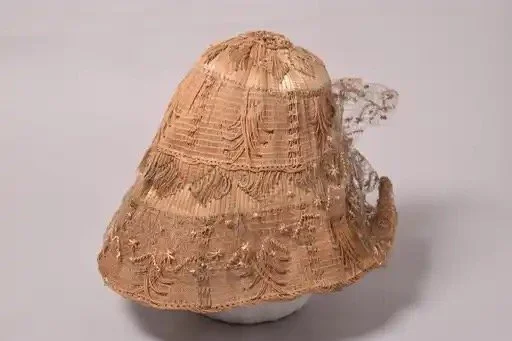
Straw wedding bonnet, 1851 © Victoria and Albert Museum, London
Sadly, straw work has become a threatened art form, partly due to the homogenisation of the kinds of wheat grown in the UK which lacks the variety that has historically been available throughout the craft’s heritage. Maris Widgeon - a long-stemmed winter wheat preferred by straw workers - is in short supply, as are the farmers who grow it.
The final straw
Thankfully, the wind is now stirring the corn as an interest in this unsuspecting material is being rekindled. Although sadly listed today as a Critically Endangered Craft, there are many voices dedicated to the survival of straw plaiting. Veronica Main MBE is among them - the former Straw Plaiter in Residence at Luton’s Wardown House Museum and Gallery and the UK’s most experienced traditional straw hat plaiter.
Meanwhile, corn dollies to celebrate the harvest are a staple of the AW26 Season Concept at womenswear company TOAST through a collaboration with Lu Towle - a third-generation grain weaver and the brains behind Braided Grain. You will find artisanal small-batch perfume makers Ffern doing the same, working with wheat weaver Rhia Davenport and Staffordshire-based Simply Straw Farm - one of the only British farms that grows the traditional straw used for corn dollies. Hay extracted from sweetgrass is blended into their Lunasa eau de parfum as a nod to this tradition - a fine and fragrant flourish for any September bride.
Following a national straw shortage after what has been a truly punishing summer, artisanal hat maker Emily Hurst made news this August when King Charles III gifted her an entire field of heritage wheat on the Sandringham state. Emily herself is a maker of fine hats for formal occasions, having been accepted into the inaugural cohort of The CHANEL and The King’s Foundation Metier D’arts Millinery Fellowship - a programme that pioneers the conservation of hat making in the UK.
Finally, no longer the domain of the mother of the bride, bridal hats are ripe for a comeback, as seen with Dua Lipa’s intimate wedding ceremony and her choice of a wide-brimmed silk hat from David Jones Millinery. While pillboxes are tipped as the hat to topple the veil for this wedding season, straw hats are enjoying a resurgence too as an elegant nod to the past, as seen with this sisal straw veil wide brim hat from Parisian hatmaker Maison Krasnova and the Elysian Boater from Awon Golding, handmade to order in London.
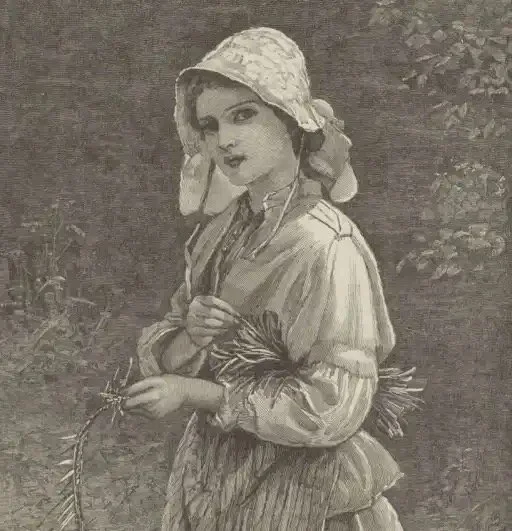
Image: a Luton lass plaiting straw, published in Penny Illustrated Paper 29th August 1885, via @thebritishnewspaperarchive
We hope that you have enjoyed September’s verse of the Bride’s Ballad. Join us next month for another seasonal deep dive into wedding traditions, superstitions, crafts and folklore.
Sources & Further Reading
Love and Courtship Traditions in Shetland
Historical Costumer 1800-1850: bonnets & hats, Liberta Books
Bend me your ears; the knotted history of straw dollies, World of Interiors
The Guild of Straw Craftsmen
Wedding Day Traditions, Ask About Ireland
Straw Costumes and Objects, National Museum of Ireland
Poor Man’s Gold, Royal Albert Memorial Museum & Art Gallery
Turning Straw into Gold, Selvedge
A Romantic Frame of Mind, V&A
Historical Preparation of Straw for Hat Plaiting, Hat Plait, Veronica Main MBE
The Shape of the Harvest, TOAST Magazine
King gives Sandringham field to hat maker amid straw shortage, The Telegraph