
Welcome to The Bride’s Ballad.
Brought to you by Lavender & Jude - the bridal boutique perched on some of the UK’s easternmost shores in Southwold, Suffolk - The Bride’s Ballad is a curious compendium of the legends, traditions, seasonal lore and superstitions that surround brides and weddings. Each month brings a new verse, using a different material, object or colour as our compass.
We hope that you will join us on a gentle amble through the folkloric and the fanciful, the traditional and the transgressive as we unpick the seams of the old ways and trace their echoes in the new.
If in October you do marry, love will come, but riches tarry.
-Traditional English folk rhyme
The Almanac
Winter is waxing as October wanes and once again, we find ourselves on the threshold. A pause, a held breath, a moment for reflection, remembrance. The light fades, the darkness crawls closer and the leaves surrender in pirouettes to the ground. It is Samhain night; the midpoint between the autumn equinox and the winter solstice of Yule, and a seminal moment in the ancient Celtic wheel of the year. Autumn’s rich, warming spectrum of russets, ambers and treacle-rich foliage, burnished by October sun is diminishing. The palette turns to white - the bleak white of the thick, clouded skies overhead, made all the clearer by the howling winds that strip the branches. Depending on where you might be in the world, white is the colour of innocence, purity; on the other, a colour for mourning, a shade for the dead. Spectral figures often haunt in white, and perhaps, most symbolically on these British Isles, it is the colour worn by a bride.
The veil between the living and the otherworld is thin and fragile as fine lace; ancestors, fairies, spirits and all manner of beings may wander astray. On this liminal night, our thoughts turn to the dead. The clocks have turned back, and we too, look behind us, over our shoulder to glimpse a figure in white, a woman perhaps, disappearing back into the shadows.
Women in white
Long before brides dressed in white, the colour came laden with folkloric significance of a different kind. Throughout Celtic lore and legend, white is a signifier of the supernatural and the otherworldly. In the Mabinogion - a fantastical compendium of the earliest Welsh folktales compiled from oral traditions in the twelfth to thirteenth centuries - we find the story of Blodeuwedd. When a man named Lleu is fated to never marry a human woman, the wizard Gwydion creates him a wife made of flowers. From the flowering meadowsweet, broom, and oak, Blodeuwedd is born. The two marry, but Blodeuwedd’s heart lies with another - a warrior and hunter called Gronw Pebr. The pair plot to murder Lleu so that their love might flourish, but Blodeuwedd’s husband can only be killed under extremely particular and seemingly impossible circumstances. The pair are hopeless until the cunning Blodeuwedd succeeds in outwitting Lleu, leaving him open to the fatal blow from Gronw. Stabbed, Lleu transforms to an eagle, soon to return with the assistance of Gwydion to seek vengeance on the couple. Gronw is killed, but the unhappy bride Blodeuwedd is transformed into a haunting white owl, condemned to never show her face in daylight again.
Y Ladi Wen or Dynes Mewn Gwyn (white ladies or women in white respectively) haunt the annals of Welsh folklore. Meaning ‘the first day of winter’, the ancient Welsh festival of Calan Gaeaf falls on 1 November, signalling the end of the harvest and the start of the dark half of the year. The night before - Nos Galan Gaeaf -is the spirit’s night and a particularly fertile time for sightings of Y Ladi Wen. These white ladies might chastise, warn and scare, guarding hidden treasures or appearing as pleading lost souls, often tricking the unsuspecting by first asking for help.
Similarly, few figures in British tales of the supernatural are as ubiquitous as the white lady. ‘A lady dressed in white fabled in popular mediæval legend to appear by day as well as at night in a house before the death of some member of the family; was regarded as the ghost of some deceased ancestress,’ writes the Reverend James Wood in the Nuttall Encyclopedia, compiled in 1907. Often dwelling in rural areas, these spectral phenomena dance hand in hand with tragedy. Unrequited love, loss, an untimely end, murder, suicide or a betrayal by their betrothed are all typical hallmarks of her tale. She may be a silent omen, or someone who asks for help before she vanishes. You may glimpse her in a photograph of those who are about to pass on. It is through such tales that we find a fine web woven between the apparition and the figure of the bride, their legends interlaced to create an enduring archetype that still haunts our imagination today.

August 1975, White Lady with Diane, photograph by Peter Berthelot
Local Legend
Like the mercurial apparitions themselves, the stories that surround these women shapeshift and change. Here in East Anglia, a host of white ladies walk our flat lands and winding lanes. Their names persist as waymarkers, evidence of their presence reflected in road signs.
White Woman Lane in Old Catton is the supposed domain of the daughter of a local squire who once fell in love with one of her father’s coachmen. At night she is seen crossing and recrossing the road between where her manor house once stood and his lodge on the other side- despite local sources dispelling any evidence of there ever having been either building on that particular road. Local lore holds that her father dismissed the coachman after discovering the illicit affair between him and his daughter. When the young woman ran out to stop the coach that would take her lover away, she slipped under the wheels and perished. Another version claims that she and the coachman had planned to marry but her father stopped the wedding, so she walks on in the dress that she never got to wear. Another, that the bride lived in Elizabethan times and was preparing to wed the lord but died the night before the ceremony. This retelling adds a wreath of herbs to the wedding gown that defines the lady’s apparition. In nearby Sprowston, the story extends alongside the lane itself. We hear tell of a young woman who wed the lord of Catton Old Hall but met her death at the hands of her husband not long after their wedding in Sprowston church. She wanders in her wedding dress from the hall, down the lane, following a path through the grounds of the lodge and on to the church. Traveller’s tales over the centuries tell of mists that appear and vanish with the power to stop a horse in its tracks, and corn in the fields that nods to her as she passes by.
Elsewhere, in the North Norfolk village of Worstead, The White Lady pub takes its name from a local haunting that occurs each Christmas Eve. While so many of these women are obscured through time, memory, and too many wagging tongues, this white lady was famously caught on camera. While holidaying in the area in 1975, Peter Berthelot snapped a picture of his wife Diane sitting in the pews of Worstead’s St Mary’s Church. As the couple later gathered to watch a slideshow of the developed pictures from their trip, they noticed an unmistakable woman in a white dress and bonnet sitting behind Diane when there had been no one else in the church. The couple returned to Worstead to show the vicar their photograph, and he told them of the White Lady who visits every Christmas Eve. On that fateful occasion in 1830, one man decided to investigate the church’s belfry after hearing of her fabled annual visitation. He was found by his friends later that night, ‘gibbering with fright’, claiming repeatedly ‘I have seen her’ according to a local newspaper clipping, before dying from the fright of it. The pub where he was staying now bears the name of The White Lady, and the original photograph taken by the Berthelots hangs behind the bar.
A Victorian phenomenon
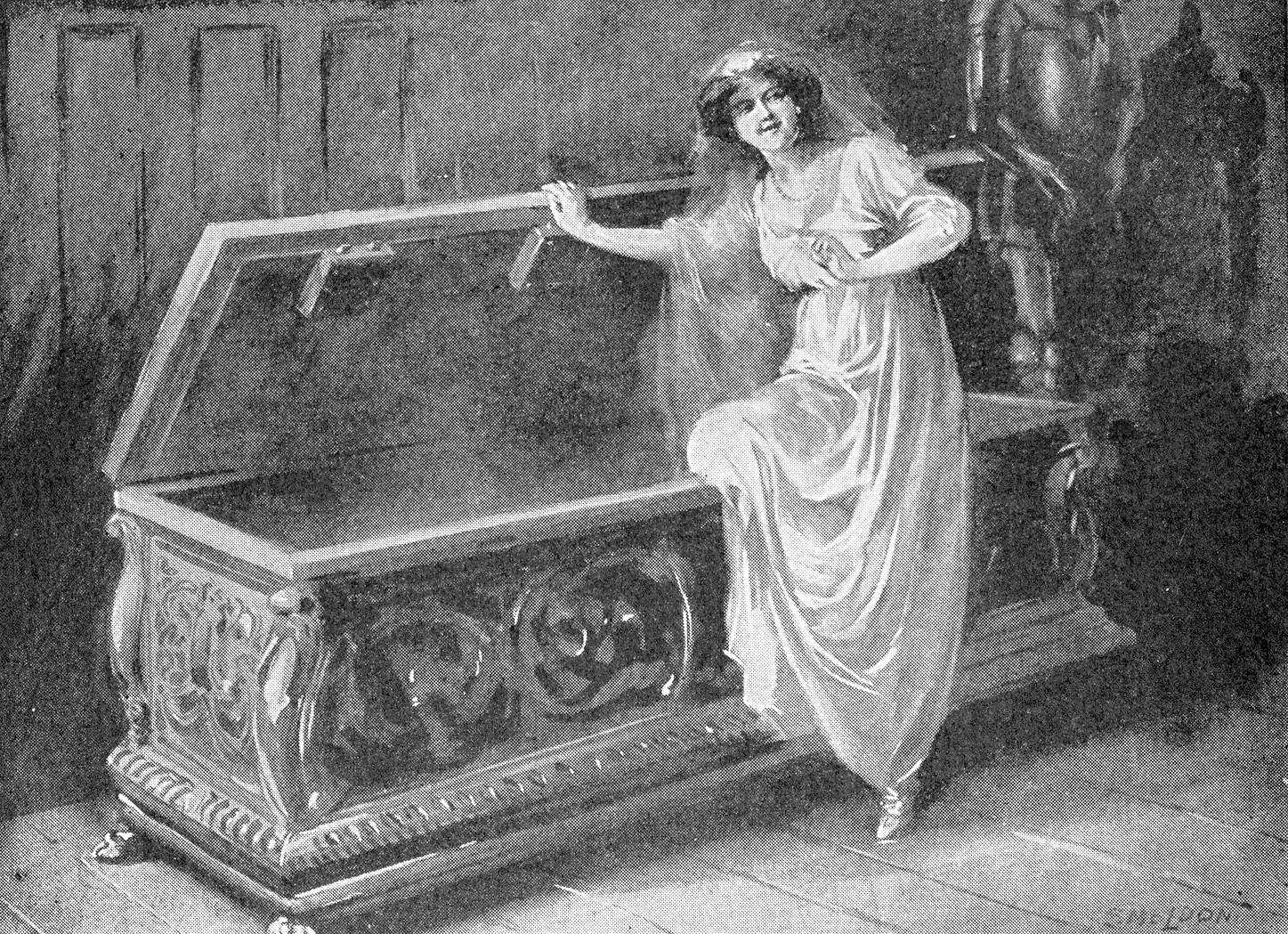
This last story places us in an era that had a fascination with the supernatural and the macabre. The Mistletoe Bough is a defining tragic bridal legend, popularised in songs, poems, etchings and even a silent film made in 1904, but the most famous was penned in the 1830s by Thomas Haynes Bayly. With the usual nuances and disputes between the location of the gruesome tale - some claim Hampshire’s Bramshill House, others Brockdish Hall in Norfolk - the bride - some say an English woman named Anne Cope, others an Italian named Genevre Orsini - ultimately instigates an ill-fated game of hide and seek during her Christmas Day wedding celebrations. When none of the guests nor her husband can find her, panic instills. It is 50 years later when the ageing husband prizes open the lid of a large wooden chest, not dissimilar to the marriage chests, or cassones, that were traditionally offered as part of a dowry. Inside lie the skeletal remains of his trapped young bride, still clad in her wedding dress and clasping her bridal wreath, the lid above defaced with her desperate scratchings.
Most significantly, it is during this epoch that a 20-year-old Queen Victoria instigates the tradition of a bride wearing white. Prior to the 19th century, white was exclusively reserved for royal weddings. For the rest of us, your Sunday best - in all manner of prints and patterns, would be worn, and worn again and again. This practicality and repeated wear chimed with the longevity and functionality of a successful marriage. White is after all, extremely impractical, although it had its place as a symbol of purity and innocence. In Ireland, this same association applies to blue - the true colour of a traditional Irish bride. It is suggested that Victoria chose to wear white in her 1840 wedding to Prince Albert to highlight the fine Honiton lace detailing on the gown against Spitalfields silk, at a time when the British lace industry was struggling. The fashion for a white wedding gown spread first to the wealthiest brides, then slowly trickled down the economic ladder but it was still several decades before wearing white became widespread. In 1889, lady's maid Harriett Joyce married one Percy Raven Sams at Earlsfield, Middlesex. At 35, Harriet felt she was just too old to wear white, and so sewed herself a gown of resplendent purple instead.

Queen Victoria by Franz Xaver Winterhalter, 1847
Another token from the Victorian era, this Christmas the BBC will adapt one of Charles Dickens’ lesser known stories - The Bride’s Chamber - for its annual A Ghost Story for Christmas, starring Jim Broadbent and Martin Freeman. And so our fascination persists - whether for the ghost stories or for the ideal of a bride in white. Two sides of the same veil, women in white captivate and enchant. The ideals they embody, the hopes that lie ahead of them, and the stories of how they were denied them, echo through the years. They clothe her like so many reams of white fabric, often obscuring the person herself. Instead, we see simply a woman in white.
We hope that you have enjoyed October’s verse of the Bride’s Ballad. Join us next month for another seasonal deep dive into wedding traditions, superstitions, crafts and folklore.
Sources & Further Reading
• Blodeuwedd, Eyri National Park
• Why do Brides Wear White, History Extra
• Why do Brides Wear White, Britannica
• Why White is a Colour of Purity That Might Just Have Killed You
• The White Lady, Norfolk Folklore Society
• How Catton White Woman Lane Got Its Name, EDP
• The White Lady Story, The White Lady Worstead
• The Legend of the Mistletoe Bride, Weird Norfolk